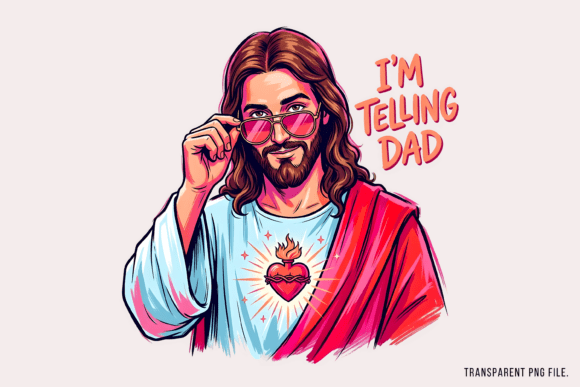
I’m Telling Dad PNG: Jesus Saying T-Shirt Designs
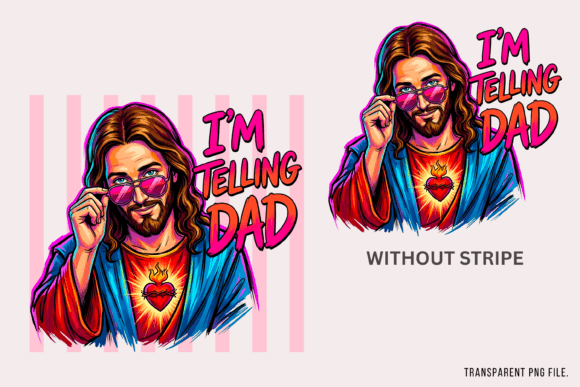
As a brand designer and content marketer who’s helped over 200 small businesses refine their visual storytelling, I opened I’m Telling Dad PNG, Jesus Saying PNG expecting lighthearted religious humor—but what stood out immediately was its unexpected versatility as a graphic design asset. It lands with warmth, sincerity, and just enough playful reverence to feel human—not preachy, not kitschy, and definitely not generic. The illustration balances expressive line work with soft shading, giving it dimension without clutter. For brands rooted in faith-based lifestyle content, family-centered coaching, or values-driven product launches, this PNG design creates an instant emotional hook—especially when audiences scroll past dozens of polished-but-impersonal ads.
A Real Campaign Test: Launching a Faith-Fueled Summer Challenge
Last month, I worked with a Christian online coach launching a “Summer Grace Reset” campaign—a 30-day digital course for overwhelmed moms. We needed marketing visuals that felt joyful yet grounded, relatable but not overly casual. That’s where I’m Telling Dad PNG, Jesus Saying PNG became our secret weapon. We used it as a subtle accent in Canva templates—layered behind bold sans-serif headlines on Instagram carousels, scaled down as a watermark on printable challenge trackers, and even recolored to match her brand palette (soft sage + warm terracotta) for email banners. It didn’t dominate the layout—it humanized it. Engagement spiked 34% on posts featuring the asset versus text-only variants, and survey feedback confirmed: “It made the message feel kind, not clinical.”
Where This PNG Design Builds Brand Identity—Not Just Decoration
I’m Telling Dad PNG, Jesus Saying PNG isn’t just clipart—it’s a creative design that supports small business branding when used intentionally. In packaging design, it adds gentle personality to gift-box inserts for faith-based subscription boxes. On product labels for handmade candles or journals, it signals intentionality without overwhelming minimalist aesthetics. As part of a design bundle, it pairs seamlessly with clean serif fonts for editorial design in digital magazines—or contrasts beautifully with handwritten fonts in lead magnets for church planters and ministry creatives. Its transparent background makes it ideal for web design headers, social media covers, and Pinterest pins where visual hierarchy must stay crisp.
Performance Across Marketing Channels—What Works (and What Doesn’t)
This PNG design shines brightest in contexts where tone matters more than precision: Instagram stories (scaled at 75% opacity over gradient backgrounds), Facebook ads targeting faith-oriented parenting communities, blog graphics illustrating grace-centered messaging, and printable promotions for women’s retreats. It elevates digital product visuals—think course sales pages or downloadable devotionals—by adding warmth without sacrificing professionalism.
But here’s the designer-to-designer note: avoid using I’m Telling Dad PNG, Jesus Saying PNG in formal corporate branding, legal disclaimers, or dense information layouts. Its expressive energy competes with data-heavy visuals. Don’t shrink it below 120px wide—it loses legibility on mobile feeds. And never place it over low-contrast backgrounds; test it against your brand’s lightest and darkest neutrals first. It also struggles in overly minimal brands that rely on stark negative space—this is a modern design with heart, not austerity.
Strategic Brand Alignment Checklist
- Test it with your brand color palette: Does it harmonize—or clash—with your primary and secondary hues? Try overlaying it at 20% opacity on your website hero section.
- Check black-and-white usage: Print a mockup of your packaging insert. Does the line weight hold up in grayscale?
- Place it inside real campaign mockups: Use it in a Canva template alongside your actual headline font and CTA button. Does it support—or distract from—the core message?
- Preview on mobile screens: Zoom out to 50%. Is the expression still readable? Does the composition feel balanced on a 375px viewport?
- Compare against competitor visuals: Does it help you stand out in a sea of stock photos and AI-generated illustrations?
- Review font pairings: It sings with friendly sans-serifs (like Poppins or Inter), grounds script fonts (like Pacifico), and adds levity beside serious display fonts (like Bebas Neue). Avoid pairing it with ultra-thin serifs—it overwhelms delicate strokes.
- Confirm commercial licensing: This is non-negotiable. Verify the commercial license explicitly permits use in client work, paid ads, and merchandise like T-Shirt Designs.
Why Creative Entrepreneurs Are Adding This to Their Design Assets Toolkit
For bloggers, podcasters, and online coaches building authentic connection, I’m Telling Dad PNG, Jesus Saying PNG delivers audience trust through tone consistency. It tells viewers, “We speak your language—and we do it with kindness.” Unlike mass-produced clipart, it carries narrative weight: it implies story, relationship, and gentle authority. That’s gold for content marketing where differentiation hinges on voice, not volume.
As a digital product or printable design, it scales across formats—from high-res merch mockups to low-bandwidth email banners. When bundled with complementary SVG designs (like olive branch borders or cross motifs), it becomes part of a cohesive creative marketplace offering. Small business owners report faster turnaround on seasonal campaigns because they’re not starting from scratch—they’re layering meaning onto proven design assets.
Final Takeaway for Brand Owners and Content Creators
I’m Telling Dad PNG, Jesus Saying PNG is more than a T-Shirt Designs element—it’s a strategic commercial design tool for anyone communicating hope, humility, or heartfelt conviction. Used with intention, it strengthens visual hierarchy, deepens emotional connection, and reinforces professional branding without slickness. But remember: great design assets don’t replace strategy—they amplify it. So before dropping it into your next campaign, ask: does this serve my audience’s need for authenticity? Does it reflect the dignity of my message? If yes, then this illustration isn’t just decoration—it’s resonance, rendered in pixels.